AI Product Concept · Product Management · Prototyping
Google Maps
Smart Arrival
“What if Google Maps planned where you leave your car, not just where you stop driving?”
I explored how Gemini could make parking part of route planning instead of a separate task after navigation begins. The concept combines parking intent, route tradeoffs, voice interaction, and arrival guidance into one continuous journey.
Independent portfolio concept. Not affiliated with or endorsed by Google.
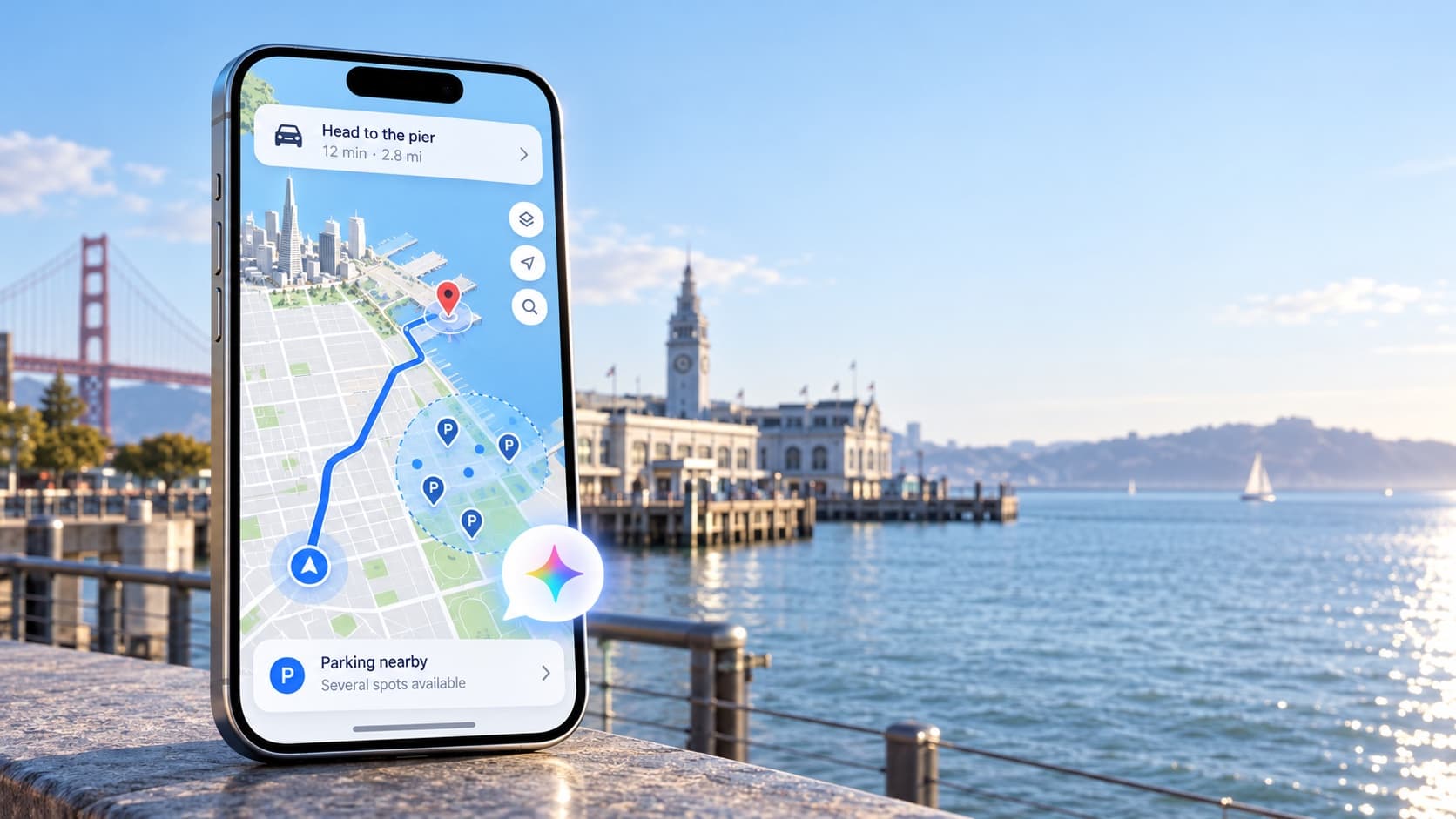
Prototype
A working iOS prototype of the full arrival journey near Pier 3, San Francisco, including a Gemini voice reroute mid-drive.
- Search
- Plan parking
- Choose strategy
- Start
- Gemini adapts
- Park
- Walk
Product / AI
Problem
Google Maps can get drivers to an address, but in dense cities the journey isn’t complete until the driver parks and walks to the actual destination.
Current vs proposed experience
Today
- Destination
- Start driving
- Ask for parking
- Inspect list
- Reroute
Parking is reactive. The driver has already committed to a route before seeing tradeoffs.
Smart Arrival
- Destination
- Parking intent
- Ranked strategies
- Start
- Drive → Park → Walk
Parking becomes part of route planning before navigation begins.
Product hypothesis
If Maps captures parking intent before navigation begins, drivers in dense cities can make better arrival decisions with fewer interactions while driving.
MVP scope
Scenario
Driving to Pier 3, San Francisco
Parking types
Street zones + garages
AI role
Intent + constraints → ranked arrival strategy
Out of scope
Payment, live occupancy, reservations, full Maps redesign
The prototype uses mocked parking data and deterministic Gemini responses to validate the interaction, AI behavior, and launch logic first.
Why AI
This isn’t “find parking.” Parking search itself doesn’t require AI.
The AI value comes from Gemini turning a spoken preference into a decision the driver can act on.
- Interprets natural-language parking preferences
- Extracts structured constraints
- Ranks arrival strategies
- Recommends one next action
Driver says
“I don’t mind walking five minutes, but I’d rather park on the street.”
Gemini extracts
- Parking type
- Street
- Max walk
- 5 min
- Cost preference
- Avoid garage
Then ranks arrival strategies by
- Drive time
- Detour
- Expected parking-search time
- Walking time
- Price
- Restrictions
- Confidence
Gemini recommends
Embarcadero curb · street parking
Best chance of a street space within your 5-minute walk.
+2 min drive · ~3 min search · 2 min walk · metered, 2 hr limit · high likelihood
Tradeoff: a likely space, not a guaranteed one. A garage stays available as a fallback.
Model behavior
- 01Lead with one recommendation, then the most important tradeoff.
- 02Keep in-drive voice responses to 1–2 short sentences.
- 03Resolve “parking” against the destination, not the current location, unless the user asks for nearby parking.
- 04Use probabilistic language for street parking: “best chance,” “likely,” “estimated.”
- 05Never claim a specific space is open unless trusted real-time data supports it.
- 06Ask one clarifying question only when a missing constraint blocks a useful recommendation.
AI evaluation plan
A test set of 30–50 scripted parking requests covering street vs. garage, walking limits, cost preferences, urgency, ambiguity, and unavailable data.
Gemini in Google Maps today (publicly documented)
Natural-language interaction
Conversational navigation requests and follow-up questions.
Route-aware search
Places along the route or near the destination.
Refinement
Refine results and add stops through Gemini.
Hands-free use
Designed for hands-free interaction while navigating.
Context
Uses route and location context.
Intent understanding
Current product baseline
Gemini supports detailed natural-language navigation requests, but Google does not publish parking-intent accuracy.
Proposed Smart Arrival target
≥95% correct destination + parking-intent classification on the benchmark set.
Why it matters
A wrong destination or parking type sends the driver to the wrong place.
Constraint extraction
Current product baseline
Gemini understands detailed, multi-constraint requests, but no public extraction-accuracy benchmark is published.
Proposed Smart Arrival target
≥90% correct extraction of parking type, walking limit, cost preference, and urgency.
Why it matters
Constraints decide which arrival strategies are eligible at all.
Unsupported claims
Current product baseline
No public hallucination benchmark specific to Maps parking.
Proposed Smart Arrival target
0 critical unsupported claims about legal or available parking.
Why it matters
Promising a space that isn’t there breaks trust and encourages unsafe searching.
Recommendation relevance
Current product baseline
Maps can return and refine place recommendations, but Google does not publish relevance scores for this scenario.
Proposed Smart Arrival target
≥4/5 human-rated recommendation relevance.
Why it matters
Leading with one recommendation only works if it is usually the right one.
Latency
Current product baseline
Gemini responds interactively during navigation, but Google publishes no Maps-specific latency SLA.
Proposed Smart Arrival target
<2.5 s parking recommendation response as a prototype / beta goal.
Why it matters
While driving, a late answer can arrive after the turn.
Task completion
Current product baseline
No public completion benchmark for destination-parking replanning.
Proposed Smart Arrival target
≥90% complete a parking-plan change without manually searching a list.
Why it matters
The point is fewer interactions while driving.
User satisfaction
Current product baseline
No public Smart Arrival equivalent.
Proposed Smart Arrival target
≥4/5 confidence and ease rating.
Why it matters
Drivers should feel more certain about arrival, not just faster.
Cost per request
Current product baseline
Not publicly available.
Proposed Smart Arrival target
Track during beta; set a ceiling before expansion.
Why it matters
The feature only scales with a known unit cost.
Risk & safety
False availability
The system should never imply that a specific street space is open without reliable live data.
Mitigation
Recommend zones and communicate confidence.
Stale restrictions
Parking rules may change by time, permit, loading zone, or street cleaning.
Mitigation
Surface uncertainty and remind users to check posted signs.
Driver distraction
Drivers should not compare long lists while moving.
Mitigation
Gemini gives one recommendation and one action.
Bad recommendation
A nearby garage can still create a large detour or poor final walk.
Mitigation
Rank total arrival cost, not straight-line proximity.
Low-confidence data
Parking data can be incomplete.
Mitigation
State uncertainty and offer a predictable garage fallback.
Bias in coverage
Historical parking data can be stronger in some neighborhoods than others.
Mitigation
Lower confidence when coverage is weak.
Success metrics
North star
Parking-aware arrival completion: drivers who accept a parking plan and complete drive → park → walk without abandoning or searching again.
- Activation
- % of eligible drivers who open Plan Parking
- Plan acceptance
- % who select a recommended parking strategy
- In-drive reroute acceptance
- % of Gemini parking recommendations accepted
- Successful arrival
- % completing the drive → park → walk flow
- Manual parking searches
- Search or list actions in the final 10 minutes
- Retention
- Repeat use on later eligible trips
- User satisfaction
- Post-arrival rating and perceived confidence
- Cost per active user
- Model inference plus routing and parking-data cost
Launch plan
Stage 1
Internal / Dogfood
- Pier 3 + small set of SF destinations
Focus
Validate flow, ranking logic, voice brevity, and safety language.
Stage 2
Limited SF Beta
- Dense SF neighborhoods
- Opt-in users
Focus
Measure adoption, recommendation relevance, reroutes, latency, and data gaps.
Stage 3
City Expansion
- Selected parking-constrained U.S. cities
Focus
Expand only where curb and garage data quality meets threshold.
Stage 4
Broader Rollout
- Eligible driving trips
Focus
Personalize arrival planning and integrate Smart Arrival more deeply into route planning.
Experience / UX
How the strategy shows up in the prototype, from search to the entrance.
- End-to-end flow
- One continuous journey from destination search to the entrance, instead of navigation plus a separate parking search.
- Parking preference
- When parking is likely to be hard, a “Plan parking” prompt asks for street, garage, or either before the route is set.
- Parking options
- Ranked by total arrival time, each with a drive + parking search + walk breakdown and one recommended pick.
- Gemini reroute
- “Find me street parking instead” returns one recommendation and waits for confirmation before rerouting.
- Immersive navigation
- Planning stays 2D; on Start the map tilts into a heading-up 3D view with street names at upcoming turns.
- Park → walk handoff
- After “I parked,” the spot can be saved and walking directions take over to the entrance.
